Cereal Killer, Quesque C’est

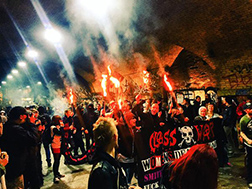
I t turns out that the riot outside our building on Saturday night had nothing to do with Rugby. It was the result of a protest by an anarchist group called Class War, which attacked a store called Cereal Killer on Brick Lane. Cereal KIller is a Café that sells only cereal, lots of kinds with different toppings (and also pop tarts and alcoholic drinks with cereal in them) and charges a pretty high price for the privilege. It’s a kind of a silly idea for a store (and I’d be stunned if there wasn’t one in NYC somewhere). Class War had CP3LVLIWsAAJF4norganized a “Fuck Parade”, which was supposed to be an anti-gentrification protest march. (That particular horse has pretty much left the barn in Shoreditch, it seems to me.) Anyway, they got to Cereal Killer, which I guess seemed to them to epitomize the hipster culture that was destroying their neighborhoods, and attacked it with paint balls, spray painted “scum” on the outside and generally went apeshit, all while the staff and customers cowered inside.
As you can imagine, the riot police were called out and busily shut off the area, preventing the parade from getting down Commercial Street from the High Street Station. Although we are the personification of all that they are protesting, I get the idea of protesting gentrification, although even the head of Class War admitted that the fight was lost in Shoreditch and he characterized the protest asa bringing the fight to the enemy. And I get that charging £3 or more for a bowl of cereal is a bit extreme, but it seems pointless to attack a little, independent shop. (However, one would have to admit that the owners of Cereal Killer have milked this episode for all it is worth and have gotten the kind of publicity for their silly little enterprise that they couldn’t even imagine. They cleverly whipped out their smart phone and filmed the attack, a video that has gone fairly viral here.)

You can’t make this stuff up…..

More stories: Sport and Art

We went to the Unitarian Church again Sunday and I was going to light a candle for the Mets, who won the NL East the night before. I ended up not doing it, partly because I figured it wouldn’t be meaningful to anyone and maybe wasn’t serious enough, neither of which was really the case as I listened to the remembrances. I still didn’t get up, because, in the back of my mind, I think I just didn’t want to jinx them before the payoffs. They have been on a pretty magical run the last two months and it has killed me to miss it (and to miss Gary and Keith and Ronny describe it). I can get videos the next morning, but it isn’t the same, and I just have trouble staying up until 3:00 AM, although I will for the playoff games, I guess. It was a nice bit of luck that the pennant clincher was a late afternoon game, so I could actually watch it from 9:00 to midnight or so.

The English Rugby team lost a 10 point lead and the game to arch rival Wales Saturday night and were eviscerated by the sporting press. That night there was all of the noise down on the street and we went out on the balcony and looked out and there were eight big police vans and the street in front of our building was closed down. We assume it had something to do with the Rugby–either excessive celebrating by the Welsh supporters or excessive sorrow drowning by the English, or a toxic combination of the two. It seemed to be mostly noise and police overreaction, but we never really heard what happened until the next day, when the guy at the front desk confirmed our suspicions.

On Saturday, we attended the London Design Festival, much of which was taking place in the “Shoreditch Design Triangle“. We went to an international design show which was set up in this empty warehouse space of what used to be Truman Brewery (the world’s largest in the 1800s), which is about three blocks from our flat. In addition to English designers there was a Norwegian Room, a Danish Room and a huge Italian section and a Korean section and even a little Lithuanian section and much more. It was really great fun and some of the things were very clever and beautiful. I spent hours walking around and chatting with designers. (Judie got sick of it and went home earlier to take a well-deserved nap.)

After church on Sunday, we realized that the Newington Green bus would take us to London Bridge, so we went to Tate Modern to see the exhibit “The World Goes Pop”. I was expecting an exhibition with lots of Warhol and Lichtenstein, etc., but it turned out that the focus was on the impact of Pop Art in the 60s on the rest of the world, so there was all of these Eastern European and South American and Asian artists influenced by the ideas and materials of Pop Art. Many of them took the use of popular culture icons and new materials (plastics, silk screening) and used them to make serious point about politics, Vietnam, repression and, especially, feminism and the role of women. The art that they created was recognizably Pop, but with more power.

Art update

I’ve continued to fiddle around with painting over the last week or so. I’ve more or less finished two more projects, so I though it might be time for a report. If you don’t feel like reading me rattle on about my thinking as a I worked on these projects, feel free to just look at the pictures and move on.

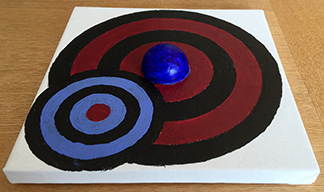
I had an idea after going to Tate Modern of trying to do something based on the idea of intersecting concentric circles. It was a nice idea graphically and it was a sort of interesting exercise in combining 2015-09-26 15.49.32colors (especially since I had a hard time coming up with colors that I liked). As I kept working on it, I realized that I wasn’t enjoying it and eventually stopped. This kind of purely graphic thing is something that I can do in a cleaner and perhaps more striking way on the computer and it was hard to see exactly what I was accomplishing doing it in paint. And if the purpose was to experiment with paint mixing and color combinations, it would be a hell of a lot easier to do it with a square in a square (like Albers), rather than laboriously painting and repainting those rings. So I just put the whole thing down for a while, taking peeks at it as I would walk past. The the other day, it occurred to me that one way to make that project more interesting would be to stop being two-dimensional. So I added a three-dimensional part (actually half a ping-pong ball), so the photo you see is where it is at now. I’m not finished, but at least I’m interested in it again.

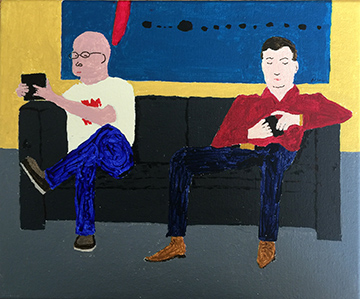
After I got sick of the circle painting, I decided to do something a little more representational. This was a little intimidating since I really don’t draw all that realistically and I’m particularly bad at hands and feet (although I’ve read that lots of artists have problems with those extremities). So, rather than trying to do a 2015-09-26 15.48.49freehand design, I decided to try a painting loosely based on a photo I took of two strangers sitting on a couch at Tate Britain, completely absorbed in their electronic devices. As I went on, I decided it would be fun to have them sitting in front of and ignoring a large work of art, so I added a Miro (although I have no idea if it is actually that big). I can’t decide whether I’m done with it. I’ve reached the point where small additions could either improve it or make it significantly worse. I’m afraid trying to make the figures more realistic could backfire and simply highlight my primitive skill set. I think I’m at the less is more stage right now, and will let it sit for a while.

Hamlet

I just got back from seeing Hamlet, starring Benedict Cumberbatch. It was very enjoyable, but I found some of the directorial decision to be just bizarre. You have to understand that Hamlet is certainly my favorite Shakespearean play. This is due to the fact that we did it in high school and, while I just had a few small parts, I went to all the rehearsals and ended up standing in when people didn’t show up. The result is that I really know the play by heart.

Benedict really was quite wonderful. I thought he delivered the soliloquies especially well and they did this clever thing in which the action stopped and he delivered the lines as if he was thinking about what he was saying while in the midst of the crowd, which I thought was more effective than clearing the stage for the speech. There are many ways to play Hamlet, of course, and he played him as fully aware, but filled with self loathing and self-disappointment that he was not acting to avenge his father’s death. He made it clear that Hamlet’s madness was faux madness, contrived for a purpose. The madness scenes were marred slightly by some silly directorial stuff I’ll complain about below. He delivered his comic lines with good timing.

Claudius, played by Ciaran Hinds (he has been in all kinds of things you have seen), was played as evil incarnate, conniving, unrepentant and murderous, which I think is a completely legitimate reading, especially for giving Hamlet some one to play against, although I suppose it might make you wonder what Gertrude sees in him (but that is always an inherent problem in the play). He was powerful and confident and delivered his big speech (that ends “My word fly up, my thoughts remain below. Words without thoughts never to heaven go.”) perfectly.

Critics complained that Gertrude, played by Anastasia Hille, was too young to be Hamlet’s mother, but we weren’t sitting close enough where that made a difference. I thought she was very good. I thought the Horatio (Leo Bill) was good, despite being stuck in a flannel shirt (which made no sense even for the time they set Hamlet in) and, for some reason, carrying a back pack in all scenes (OK, it makes sense when he has just arrived from Wittenberg, but he would have taken it off when he was in the castle). The scenes with the ghost were effective and the gravedigger’s scene was appropriately amusing. The whole play within a play (which can be kind of clunky) was handled very well.

All of the above made it a completely enjoyable evening, but there were so many weird directorial decisions, that it really distracted from the enjoyment of the performances. Here is what annoyed me the most:

  • The whole thing was set is some sort of mid-20th century time, but without conviction. The guards carried guns on the ramparts and Laertes show up at the end with a pistol to avenge his father, but some of the costumes and the set in particular didn’t fit the period. And if you ask me, having people waving guns around for the whole play makes the fencing at the end seem contrived.
  • The set in the first act was sort of the huge main room in the castle, with a staircase up one side and giant doors going out the back and various other ways to exit and enter. It worked pretty well, even for the scene where Hamlet meets his dead father. But in the second act, for no explainable reason, the set has been filled with what looks like crushed rock or dirt, all over the set and out the back, through the huge doors and going up maybe ten feet. It was initially impressive and was great for the graveyard and scene on the battlefield with Fortinbras, but it made no sense for the entire rest of the second act, especially Ophelia’s mad scene and the final duel. I’m sure they were trying to make some sort of point about war or something, but it was idiotic.
  •  The interpretation of Polonius missed the boat. It seems to me that Polonius is in the play to provide some comic relief as a blustering windbag and they utterly failed to mine the comedy in his part. The most egregious failure was in his scene with Laertes (“In these few precepts in your memory write”), which is not about the precepts (which are, of course, iconic bits of wisdom) but about the fact that he is going on and on while Laertes wants to leave. In this case, they have Polonius reading it from a pad of paper, effectively killing the scene. They simply threw away the whole scene with Hamlet and the clouds (“Do you see that cloud in the shape of a camel”) to the point where they might as well have cut it. The problem with this whole approach is that, in failing to make Polonius a comic foil, he is just some sort of court functionary and not the lovable windbag that the audience has some feeling for and his accidental death is not as wrenching.
  • The scenes with Rosencranz and Guildenstern were also pretty flat. Less amusing banter between old friends, at least at first, which, again would have made their betrayal of Hamlet and eventual death more effecting.
  • The Ophelia scenes also didn’t really work. The “Get thee to a nunnery” scene was pretty good, but was lacking something (I’m not sure what). And her mad scene after the interval was simply interminable. Of course, it didn’t help that she was barefoot and wandering over all of those stupid rocks and occasionally doing completely pointless stage business with them. Speaking of pointless stage business, they also had her carrying a camera around taking pictures (it was hard to see what that added to the character) and then dragging around a trunk of photos during the mad scene. (OK, you tied it together, but why?)
  • I suppose the director was trying to make some sort of point about Hamlet’s faux descent into madness by having his dress in funny costumes and use use silly props in those scenes. I really don’t think Cumberbatch needed the help to make the point and it was really directorial hubris. It didn’t ruin the scenes because Benedict carried it off, but it was nonsensical.

I think sometimes directing involves getting out of the way. I’m so glad I went and it really was very good, but it should have been better with his performance at the center.

A few additional thoughts the next day: Hamlet, uncut, is at least five hours long, so the decisions made on what to cut and what to leave in are crucial. Here, the decision was made to make the focus of the play the battle of wills between Hamlet and Claudius, which makes sense and was helped by superior performances by the two actors. Less emphasis was placed on Hamlet’s almost Oedipal rage at his mother. The whole Fortinbras subplot is often just cut out completely, but that was left in here to make the play about politics and power and not just a son’s revenge. I get the decision, although there is a reason that the Fortinbras scenes are cut–they are boring and lack the soaring language of the rest of the play. I think the decision to emphasize the struggle for power and politics may explain why Polonius and Rossencranz and Guildenstern were played more as court functionaries rotating in the orbit of Claudius, robbing them of their dimension and the play of much of its wit. (A big mistake, as I noted above.) I’m not sure exactly what was cut, although the whole interlude with the players seemed far shorter than I remembered. Finally, given the decisions that were made to make the play centered more around Hamlet and Claudius, why did they leave in the entire Ophelia mad scene and try (unsuccessfully) to milk it for all it was worth? It was a scene that was so long and so out of place with the rest of the production’s sensibilities that the play lost its pace.

But Cumberbatch was great.

Short Stories

Actually, a lot has happened over the past two days. But before I get to that, a political story:

After a week where Jeremy Corbyn was constantly getting slammed by the media, now it is Prime Minister David Cameron’s turn. It all began when, Lord Ashcroft, a big Cameron supporter who was supposedly pissed off when he wasn’t appointed to anything when Cameron won the election the first time, justpig-gatge released a memoir, which states that when Cameron was in Oxford and trying to join an exclusive eating club, he went through a hazing ritual involving a pig’s head and his penis. It is already known as “pig-gate” and has led to things like the photo to the right. Cameron is a sort of non-Mormon Romney. Rich and out of touch. The story may not be true, but it sounds like it could be one of those things that happens with rich, elite types at Oxford, something like Skull and Bones rituals at Yale involving the Bushes. I’m not sure it even makes sense for Cameron to deny it. I think he is hoping that it just blows over.

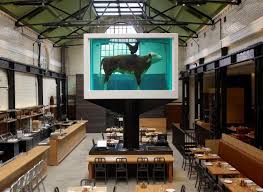
My cousin Sarah is visiting London, with her two nieces, Hallie and Charlotte, tramshed Hallie’s fiance and one of their friends. At the same time, Alex’s high school, Band and Portland friend Philippe is staying with us for tow nights before starting a tour of England. (He is a singer-songwriter, with a real American/Johnny Cash sort of sound, which goes over great here.) On Monday night we all went to dinner at Tramshed a, beef and chicken place in Shoreditch in an old power station for the trams. The food is good and the atmosphere is great, but the restaurant’s biggest claim to fame is a Damien Hirst artwork–a pickled cow and chicken in a tank that dominates the space. See the photo.

I met Sarah et al. for drinks today in Mayfair, after walking around by myself checking out expensive galleries and finding the Ai Wei Wei exhibit (but too late to go in so I’ll have to go back). I also went to the Royal Institution, which was started in 1799 by the leading scientists of the day to promote scientific knowledge. I went to the auditorium where famous countless important scientific lectures were held about the nature of electricity and the discovery of chemical elements, etc.. They still have them and the Christmas one is very famous and sells out.

On Wednesday, I’m going to see “Hamlet” with Benedict Cumberbatch, thanks to Charlotte, who has an extra ticket, while Judie goes to a payments conference in Surrey. Tonight, we just saw “Mr. Foote’s Other Leg”, a play based on the true story of Samuel Foote, an actor/comedian in London in the 1700s, who at one point has an accident which leads to the amputation of his leg, but continues to perform, using his lack of a leg for humor. It starred Simon Russell Beale and a mind-bogglingly great cast. It really was a marvelous play. In the 1700s, under the King’s law, only the two royally designated companies were allowed to put on plays and all new plays had to be reviewed by the Lord Chamberlain. Foote got around this by inviting the public to his “tea parties” and charging for the tea but not the performance and then improvising the performances so that there was no script to review. He would do things like put on “Othello” as a comedy. He was friends with Ben Franklin and Prince George (later George III) and there is a whole sub-plot involving scientific lectures. A bit of a love letter to the theater, it was funny and sad and thought-provoking. And Kevin Whately, who played Inspector Lewis in the “Mystery” series was in the audience for an added little thrill. The performance was at the Hampstead Theater, which is a small theater in Swiss Cottage, which is near St. John’s Wood. It seems to be one of those theaters that produces things that move on to the West End, kind of like New York Theater Workshop or the Public Theater. I’m thinking that we should subscribe.

Unitarians in London

On Sunday, Judie and I decided it was time to go and visit a Unitarian Church. There are only a few in London and, when we had dinner with Craig Hirshberg, she recommended New Unity Church on Newington Green, which is where her daughter goes. So I checked and figured out that there is a bus from Finsbury Square ( a 10-15 minute walk) right to Newington Green, which is nearby, but not to be confused with, Stoke Newington. (You have just got to love English place names. Between railroad stops and London Streets, I think you could find every strange Raould Dahl name that you thought he had just made up.) So we took the 25 minute ride up to Newington Green, getting there way too early for the one 11:00 service.

It was enjoyable. The theme of the sermon was forgiveness and atonement, as it was close to Yom Kippur. The minister, who was originally Jewish and From New York set the right tone, the choir was tiny but spirited and the music w500px-Unitarian_chapel_newington_greenas quite good. The service would have been familiar to any UU from Montclair, although there were many little differences. Of course, one of the big differences is that is a much smaller congregation, with slightly over 100 members. There were around 40 there when we went, plus 10-12 kids who trooped off for Religious Education. A significant percentage of the congregation appears to be American, which makes sense because, while the UU faith is not terribly strong in the US, it is far more significant than it is here. In fact, according to what I subsequently read, Unitarians almost disappeared completely around 2000 in the UK and are now making a very, very slight comeback. One of the leading lights in this comeback is the Newington Green Church, which was down to around six members at one point before being revived by a student minister and then the current minister, Andy Pakula. He is at the forefront of the efforts to grow Unitarianism over here. (If you are interested in reading more on this topic, you can check out this article from UUA World.)

Like seemingly everything in England the Newington Green Church has a long history. Newington Green was the home of the nonconformist movement and the Church was built there in 1708. It’s peak in influence or at least fame may have been in the late 1700’s when its minister was Richard Price, a radical and republican, who supported the French Revolution and believed America’s rebellion to be justified. He was visited by John and Abigail Adams, Thomas Jefferson, Thomas Paine and Benjamin Franklin while they were in England and welcomed Joseph Priestly, discoverer of oxygen and a founder of British Unitarianism, when Priestly was driven out of Birmingham for his views. His most famous congregant was Mary Wollstonecroft, perhaps the original feminist, who wrote “A Vindication of the Rights of Women” in 1792. There is long Wikipedia article on the history of the Church, which is pretty good reading if you are interested.

I’m quite sure that we will be back. Judie is interested in joining their choir. And we need to find a community of like-minded folks. What better place?

Rugby Fever

I’m will to be bet that no one in America who isn’t from a Commonwealth country knows it, but the Rugby World Cup started Friday night in England, with the home side playing the opener against Fiji. People are quite excited about it here. Not Super Bowl stupid levels of excitement, but as excited as Brits are allowed to get. The Cup itself was on display at Spitalfields market the other day and there was a gigantic line of people of all ages and sexes waiting to have there photo taken with it. A woman at Judie’s office was told that holidays are out for the next six weeks because her husband and son cannot miss any of it.

When we lived in Australia, I used to casually watch Rugby League and the Rugby Union matches when The Kangaroos played The All Blacks (New Zealand). The highlight for me was the start of the games with New Zealand when the All Blacks gather in the center of the field and dimageso the Hakka, a Maori war chant with appropriate steps and and arm motions and the sticking out of tongues. When they do it Aukland before a sold-out crowd, the place is in an absolute frenzy at the end. It is really worth seeing. (Fiji did their own war chant before playing England the other night, but, since they were playing over here and it is just Fiji and not the mighty All Blacks (multiple world champs), it didn’t have the impact.)

Judie was running late from work on Friday, so I decided to watch some of the England-Fiji game. I found that, while I loosely recalled the general rules, there were countless things that I didn’t understand and the strategy was a complete mystery to me. I kept finding myself thinking “Why is he kicking it now?” or “Why did that guy with the ball just run straight at the other team?” or “Why is there a scrum now?” or “Why is it most of these idiots don’t wear helmets?” or “I wonder how many of them have concussions by the end of the game?”. It is a baffling game that is mostly smashing into the other team and occasionally lateraling the ball (but never passing forward) or kicking forward for no apparent reason. It seems like it must be a primitive game or at least derived from a primitive game in which the serfs got a pig’s bladder and beat the crap out of each other. I suppose I’ll end up watching it a little, just to be able to talk to the rest of the country. I’ll let you know if I ever figure it out.

One final really weird thing about English Rugby: For reasons that apparently are not entirely clear, “Swing Low, Sweet Chariot” is the unofficial anthem of the English Rugby team, which the English fans sing loudly and boisterously whenever the lads pay a game. There is now some debate about whether it is appropriate for a bunch of drunken white fans to be singing a black spiritual about slavery. (Imagine if it was a tradition to sing it at the Masters golf tournament and the reaction in the US.) Actually, I don’t think there is much question that it is entirely inappropriate, particularly for a white, upper class sport that has had a history of ugly racist incidents. But there isn’t much chance that this will change.

More Random Thoughts

Restaurants don’t serve ice water. They will bring you water, but never any ice. They will sometimes bring ice if you ask for it separately. Is this somehow related to warm beer?

They don’t use manila folders here. You can’t seem to even buy them, at least not easily. Instead they seem to use those clear sheet protectors, which are stored in notebooks.

British drunks are different from American drunks. They just seem to be happier. We were stuck on a crowded tube, cheek by jowl with some clearly wasted 20 somethings. One of them reached up and began tickling Judie’s armpit (she was holding on) and started giggling when she gave him the inevitable look. They wanted to know where we were were from and assured us that the best place on earth is Lincolnshire before we left the train. The other thing British drunks do is sing. It is sometimes at 2:00 AM and on the street in front of our building, but I’ll take that over fighting or yelling.

On the spur of the moment, we went to the theater Wednesday night. We could never really do that living in Montclair (too complicated). So this should be one of the great things about living here. Judie had no evening calls (for a change), so I stopped by Leicester Square on my way back from Tate Britain and bought tickets to “The Curious Incident”, which we somehow never got around to seeing on Broadway. The staging was so spectacular that it sometimes overwhelmed the story, which was probably a good thing, since the story was actually pretty predictable after a certain point. Some wonderful performances (I though the actor who payed Christopher, the boy, was terrific–he has to be for the play to work–and the actor who played his Dad was also particularly good). A great piece of theater. It’s weird not getting Playbill (the way British theater works–unless you buy it), so I can’t tell you who I saw. I wonder what the rationale is for that.

Here is what I have to do to make a payment on line with HSBC: I go on the website, hit log on, put in my user name and password and then take out my HSBC Security Device (see photo), push the green button to turn that on, enter a different security code, push the green button again and then enter the HSBCresulting six digit number on the sign in page and I then hit continue and you finally get online. Then, to make a payment, I pick the payee (assuming I have gone through the ordeal of entering the payee previously) fill in the amount and date, and then pull out my trusty HSBC Security Device, push the green button, enter my security code, and the this time push the yellow button and enter the last four digits of the account I have entered for the payee when I set it up, then hit the yellow button again, which results in another six digit number, which I then enter on the page, hit continue and then confirm that yes, I really mean it.resulting six digit number on the sign in page and I then hit continue and you finally get online. Then, to make a payment, I pick the payee (assuming I have gone through the ordeal of entering the payee previously) fill in the amount and date, and then pull out my trusty HSBC Security Device, push the green button, enter my security code, and the this time push the yellow button and enter the last four digits of the account I have entered for the payee when I set it up, then hit the yellow button again, which results in another six digit number, which I then enter on the page, hit continue and then confirm that yes, I really mean it. The mind boggles. Yet the same bank lets you just wave your debit card at the card reader if the bill is less than £20, with no PIN number or anything.

I’ve been putting together two small desks we bought for the flat. This is always a miserable task, but it is especially awful with the pathetic little tools that are provided. And then I realized that they sent the wrong parts for my desk and I discovered that I’d misplaced three of the little screws for Judie’s desk. I decided it was time to take a sanity break. Next day–Following the wisdom of Mr. Natural (“Get the Right Tool for the Job”), I went out and bought a real screwdriver with different bits, had a physics lesson on the importance of torque, found the little screws, got the replacement parts, and finished the desks without killing myself. The best £10 I’ve spent here so far.


Barbara Hepworth

I braved a steady rain (I’m in London–I might as well get used to it) and a few new lines on the Underground to go visit Tate Britain today. I went to see the Turners and just poke around, but ended up going to a special retrospective they were having on Barbara Hepworth. Never heard of her? I have to admit, I’d never heard of her either, but as I walked through the exhibition, which was pretty amazing, I realized I’d seen her work before, almost certainly at MoMA and probably at other places. The sculptures were just incredible. The question I kept asking myself as I walked through the museum and then on the Tube back, was why isn’t she a household name in the same way that Henry Moore is?

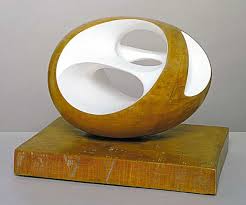
Hepworth is every bit as great a sculptor as Moore. They are both Modernists and essentially contemporaries and their styles are comparable in many ways. I think I might actually like her sculptures a little better, but it is a little like comparing Michaelangelo to Bernini. She started out in the 20s doing these amazing carvings of animals and people that have a sort Native American or African sensibility, which got people’s attention. She then moved on to more the abstract forms that she continued through out her life. She was buddies with and/orimgres exhibited along side all the great artist of her day–Arp, Mondrian, Man Ray, Calder, Miro,you name it. She was really very famous in the 1950s and 60s, possibly as famous as Moore and the others at that point. She has a sculpture at the UN honoring her friend Daj Hammaskjold. By any measure, she is one of the greatest sculptors of the 20th Century and really one of the great artists of the mid 20th century. So why is it that I don’t know her name in the same way that I know Calder and Moore and Jasper Johns and Richard Serra and plenty of other artists? Is is that she is a woman? Is it just me?

I have no doubt that there is an element of sexism in this. A walk through any museum will demonstrate this. But I’d say that there is more going on. One important factor is the work itself. Hepworth worked for most of her life carving sculptures out of wood or stone. That is labor-intensive and time-consuming, so the simple number of her works has to be relatively smaller, possibly leading to fewer opportunities for collectors and exhibitions. In contrast, If one is casting in bronze (which she only did late in life), one can make multiple copies of a work. And the works themselves are really designed to be in nature and are simply not massive in size, in contrast to artist like Moore or Serra. Thus, if you are a real estate developer, a rich guy with money to spend or a municipality, and you want to buy an “impressive” piece of public art to put in front of your new high-rise, in your yard in the Hamptons or in the reflecting pool at Lincoln Center, you are not going to be interested in her smaller, more contemplative works. But that seems too simple and there are many artist who work on a human scale whose names you know.

This got me thinking about “Sunday in the Park with George”. The first half of the Sondheim musical is about art as an obsession, while the second is about art as a business. To be a successful artist, you have to market, not just your work, but yourself. Simply being talented and creating good art is not enough. You have to be able to present an appealing case of why your art is meaningful and why you are an important artist with a significant point of view. I wonder if this is one of those things that men are better at than women? Or at least were? Of course, Hepworth was a very successful artist who was world-renowned, so it is clear that she was capable in the area of self-promotion. But perhaps she wasn’t as great at it as a Picasso or a Warhol? it is hard to tell if the point is valid for her, but I wonder if it isn’t generally so?

Anyway, do a Google Search on Hepworth and if you happen to be in London, before October 25th, go see the Exhibit at the Tate.

Overseas Politics

We just got broadband internet. I had no idea how much I would miss not being able to get on line easily. I’ve spent most of the past two weeks watching little balls spinning or getting timed-out/error messages. I feel like my life can resume now…..

The big political news here is that the Labour Party has changed leaders, electing Jeremy Corbyn to be the new Shadow Prime Minister. (One of the cool things about this Parliamentary system is that the opposition party has to name an entire cabinet, who argue their issues during Question Time. Thus there is a Shadow Foreign Minister, a Shadow Chancellor and on and on. If you were paying attention (and it questionable whether anyone does), you would have a pretty detailed idea about the opposition’s policies and what they would actually do if they held office.) The weird thing is that they chose the Shadow Prime Minister (at least in the Labour Party), not by a vote of the Labour MPs or some other inner circle, but through an election in which all members of the Labour Party can vote. I don’t know if this is a new process, but it was apparently new that you could join the Party for £5, so Labour suddenly had an incredible membership increase, which helped Corbyn, the outsider, and hurt all the insiders. The most surprising thing about the election, at least to me, was that the voting closed at noon or something on Thursday and the results were not announced until Saturday morning. If it had happened in the US, the networks would have been falling all over each other to call the race within seconds after the last vote was cast. And it wasn’t close, although in fairness, the media so completely missed the outcome of the last real election, that they might have been feeling a little gun shy. But they all acted like it was a big mystery for about 36 hours. The pace is slower here in some ways.

Corbyn is like that lovable radical history professor at college, who never wore a tie, went to all the protests and said outrageous stuff. Corbyn has been sitting on the back bench for many years (probably not wearing a tie, going to all the protests and taking far left positions). As Krugman pointed out in the Times, he won because the rest of the Labour leadership had turned in Conservative-Lites, agreeing with the Tory and media narrative that austerity is the only answer for the British economy, which was brought down by overspending by prior Labour governments, when actually none of that is true. So the entrenched leadership had nothing much to offer, except to say that the government should be nicer to working people, while generally supporting Tory policies that screwed them. (And the Tories, faced with no credible opposition, has decided to fulfill its wildest wet dreams by launching a sweeping, vicious attack on unions that would make Scott Walker jealous.) So Corbyn was thrust into this void, with a larger electorate who were apparently pretty sick of the old guys and happy to hear from someone who said that austerity was idiotic and that England needs to spend money to help the working class, even if it mean raising taxes on the rich or scrapping military spending. As I understand, it the leadership suggested that he be added to the ballot so that they would have someone representing the Left and probably figured he had no chance. They never knew what hit them.

Now that he is in, the Murdoch-owned media is in full dudgeon, complaining that Corbyn is some kind of wild-eyed radical socialist (he is much further left than Bernie Sanders–in comparison, Bernie is Hillary), who will endanger the British economy, personal safety, it place in the world, etc. Part of the explosive reaction in the press and from the Conservatives is political, but it is also a reaction to the shock of having an outsider win. Everyone who matters was comfortable with the old leadership (except working people and the Labour membership) and they are outraged and perhaps a bit threatened by this change, which also brings a number of other back benchers up to the front bench. (It reminds me a little of the reaction that Jerry and Kathryn and Cary and I got when we were elected to the Town Council. The clique of people who had always run things in Montclair were suddenly out and could not accept it and spent the next four years attacking everything we did. I don’t think it is a coincidence that, having elected the Jackson slate that returned things to the old Montclair ruling class, criticism of the current Council has been nonexistent.) Anyway, it is pretty clear that Corbyn is going to be under continual attack. He was immediately criticized for not naming more women to his Shadow cabinet, even though a majority of the shadow cabinet were women. Today he was criticized for failing to sing “God Save the Queen” at some ceremony, even though he stood in respect. What he is going to have to do in the coming year is win the battle of ideas, assuming he and Labour can be heard over the negative din.

Meanwhile, in Northern Ireland, the government is on the verge of collapse, essentially because the Protestants suddenly remembered how much they hate the Catholics (and probably vice versa). It all started when some remnant of the IRA was connected to a recent murder and the main Protestant Party used it as a way to attack Sinn Fein, which couldn’t see why it should be blamed. It all seems pathetic to me, but it seems likely to bring down that government.

And in the Colonies, the Prime Minister of Australia was ousted. He was the leader of the Liberal Party (which is conservative in Australia just to confuse you) because he was too big a jerk even for the Liberals and his Neanderthal statements on same-sex marriage were hurting the party.